
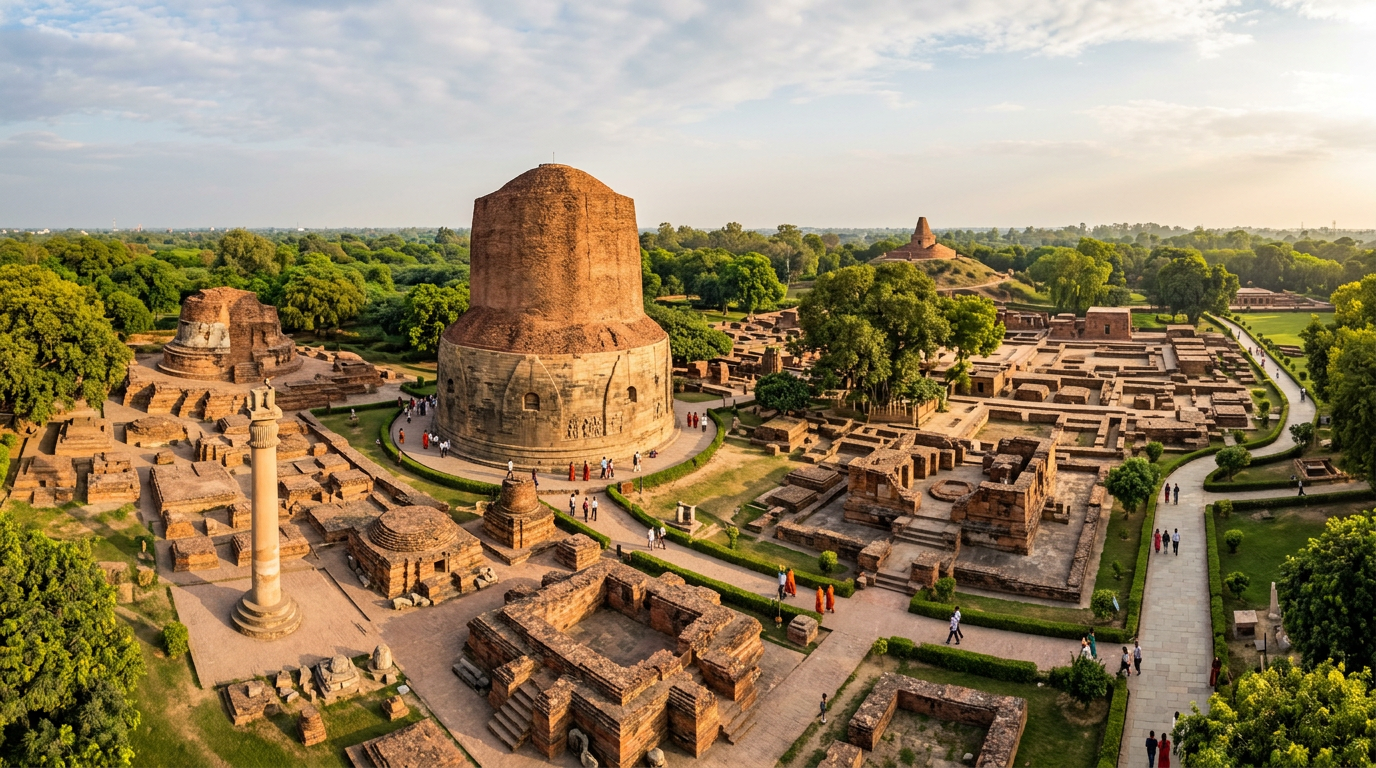
Sarnath Becomes a UNESCO World Heritage Site: History, Significance, and Major Attractions
Why is Sarnath in the News?
After remaining on UNESCO’s Tentative List for nearly 28 years, Sarnath in Uttar Pradesh has finally been inscribed as a UNESCO World Heritage Site. With this recognition, Sarnath has become the fourth UNESCO World Heritage Site in Uttar Pradesh.
Earlier, the state had only three UNESCO World Heritage Sites:
- Taj Mahal
- Agra Fort
- Fatehpur Sikri
All three are located in the Agra region.
Where is Sarnath Located?
Sarnath is one of the most sacred pilgrimage sites of Buddhism, situated about 10 km northeast of Varanasi in Uttar Pradesh, India. It is among the four major Buddhist pilgrimage sites and attracts millions of devotees and tourists from across the world every year.
Religious Significance of Sarnath
Sarnath holds immense importance because Lord Gautama Buddha delivered his first sermon here after attaining enlightenment at Bodh Gaya. This event is known as the Dhammacakkappavattana (Turning of the Wheel of Dharma).
It was at Sarnath that the formal propagation of Buddhism began.
Ancient Buddhist texts refer to Sarnath by the names Rishipattana (Isipatana) and Mrigadava (Deer Park).
Historical Importance of Sarnath
During the 3rd century BCE, Emperor Ashoka built several monuments at Sarnath, including stupas, monasteries, and the famous Ashoka Pillar.
The Lion Capital of Ashoka, originally erected at Sarnath, is now the National Emblem of India, symbolizing the country’s rich cultural and historical heritage.
Major Attractions in Sarnath
Dhamek Stupa
The Dhamek Stupa marks the site where Lord Buddha is believed to have delivered his first sermon after enlightenment.
Chaukhandi Stupa
This stupa commemorates the place where Buddha met his five former companions before delivering his first sermon.
Mulagandha Kuti Vihara
A modern Buddhist temple renowned for its beautiful murals, peaceful surroundings, and meditation hall.
Ashoka Pillar
Commissioned by Emperor Ashoka, this pillar is one of India’s most significant archaeological monuments. Its Lion Capital serves as the National Emblem of India.
Significance of UNESCO World Heritage Status
The inclusion of Sarnath on the UNESCO World Heritage List is expected to:
- Enhance its global recognition and cultural prestige.
- Strengthen conservation and preservation of its archaeological heritage.
- Boost international tourism and pilgrimage.
- Generate employment and support the local economy.
- Promote India’s rich Buddhist heritage and strengthen cultural ties with Buddhist nations.
Conclusion
Sarnath is not merely a religious destination; it is a living symbol of India’s spiritual, historical, and cultural legacy. From Lord Buddha’s first sermon to Emperor Ashoka’s remarkable contributions, Sarnath has played a pivotal role in shaping Buddhist civilization. Its recognition as a UNESCO World Heritage Site further reinforces its importance as a global center of heritage, peace, and learning.